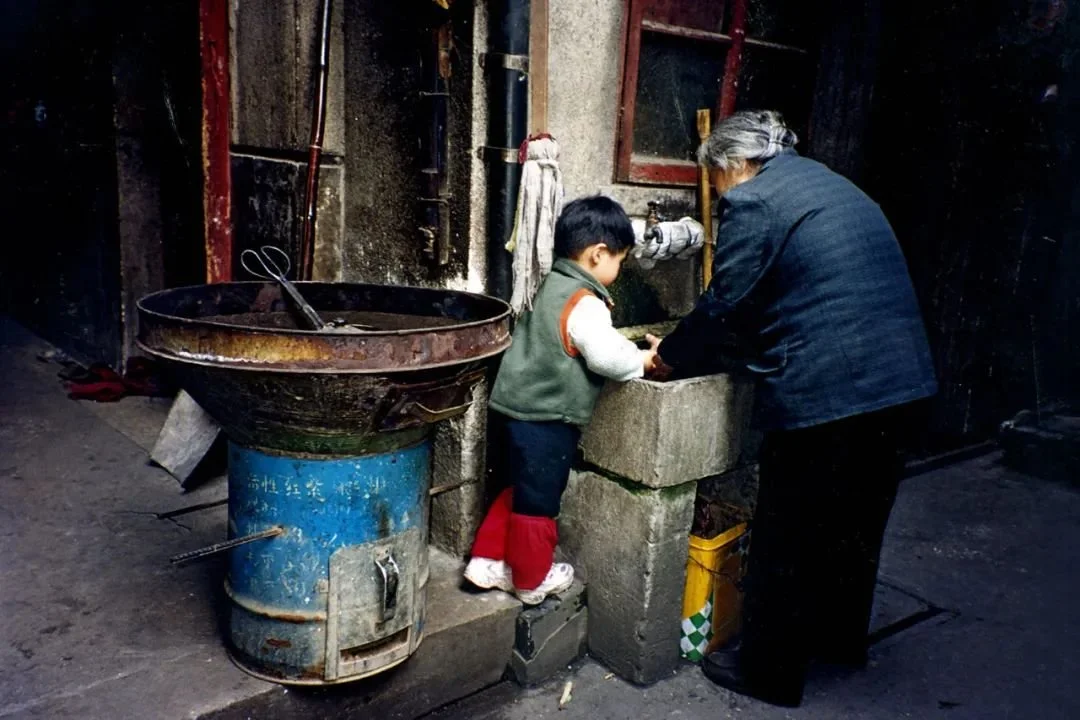
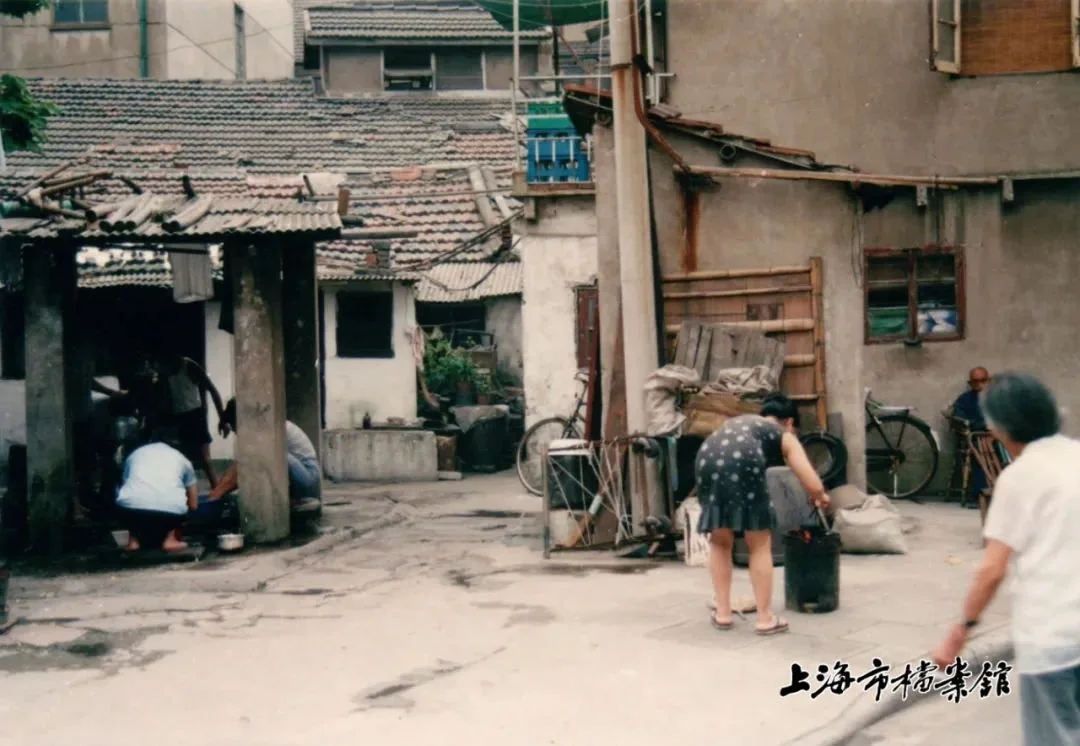
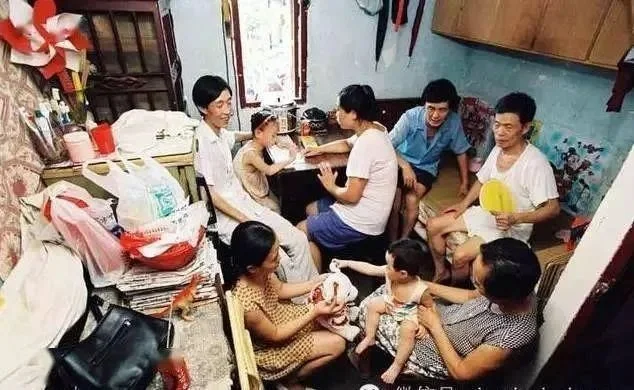
Photos of Shanghai’s Shantytowns.
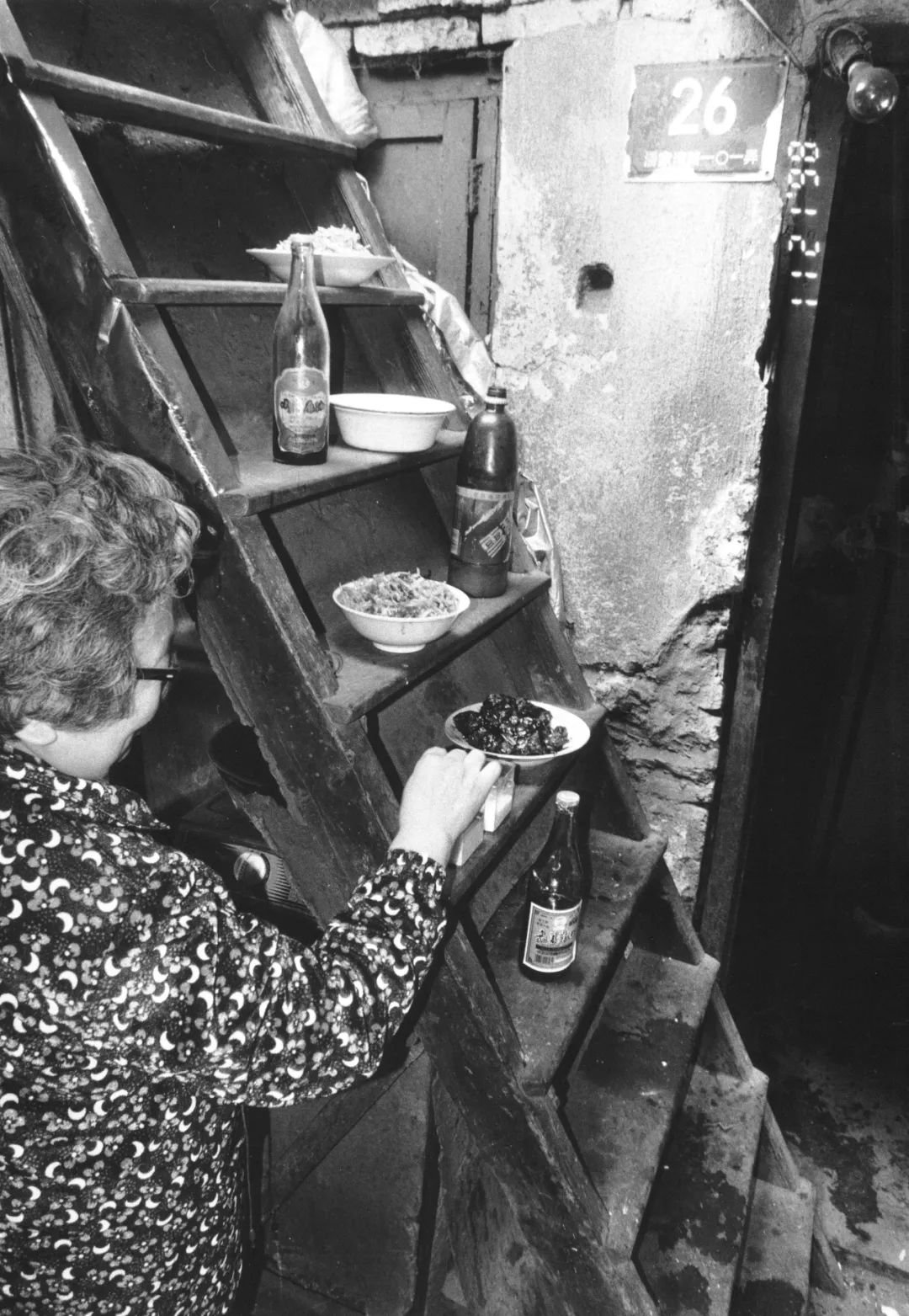
For shantytowns, cooking is a challenge — space was so limited that people had nowhere but on stairs to place ingredients and half-prepared dishes.
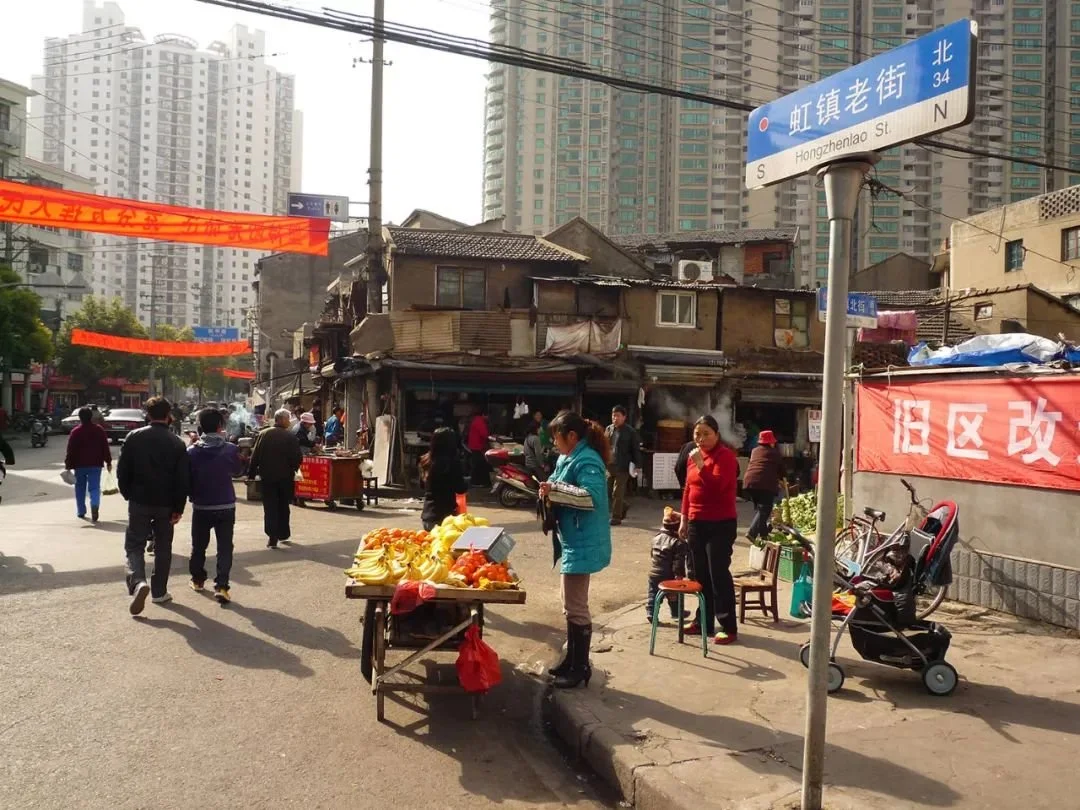
Residents of Hongzhen Old Street saving their final farewell to their old home before moving.
At the start of the Reform and Opening Up period, housing conditions in Shanghai were extremely difficult. Residents in the city centre lived in severe overcrowding, with an average living space of only five to six square metres per person. Across sprawling shantytown districts, the environment was filthy and dilapidated, basic amenities almost non-existent. Families crammed several people into rooms of just a few square metres — at night, people slept not only on beds but on the floor. When it rained, water leaked through the roof inside.
A city as significant as Shanghai could not indefinitely exist with gleaming towers on one side and crumbling shacks on the other. To address the housing crisis, Shanghai launched urban renewal projects in the 1980s, and from the 1990s onward began large-scale demolition of dangerous and makeshift dwellings. Decades later, living conditions for Shanghai residents have dramatically improved. In 2022, Shanghai completed its programme to redevelop all remaining concentrated lower-grade old neighbourhoods, with subsequent work shifting toward scattered renovation, upgrading of older housing stock, and urban village redevelopment.
Through the accounts of those who lived it, and through archival records, we revisit the stories of Xiangfen Lane, Xiling Jiazhai, the "Two Bays, One Estate," and Hongzhen Old Street — scenes from Shanghai's urban renewal past that remain vivid to this day.
From "Water and Fire" to a Dream Come True
Xiangfen Lane, off East Nanjing Road, was home to a notoriously dangerous building. Cai Yue'e, a former resident, recalls that the floorboards had wide cracks through which things would fall, and were so uneven that one could easily miss a step. The bannisters were loose — one wrong grab and you'd tumble down. The rooms were tiny, only seven or eight square metres each, like pigeon coops, with people packed onto beds and floors every night.
The ground floor of the building housed the Sanyang South Grocery. The shop still stands in its original location today, and a veteran worker there has vivid memories of that since-demolished building: "Whenever they mopped the floor upstairs, water would drip down on us. So we rigged up a canopy inside the room."
In 1985, Xiangfen Lane was cleared for demolition and Cai Yue'e and her neighbours moved to Meiyan New Village in Pudong — independent units with their own kitchen and bathroom facilities. They were among the earliest Shanghai residents to have their housing difficulties resolved through relocation after the Reform and Opening Up era began. "I felt very content," Cai said. "It was incomparably better than what I grew up in. Turn on the tap, wash whenever you want — it was like night and day."
Through the 1980s, due to the weight of historical underinvestment and rapid population growth, Shanghai's urban renewal challenge was immense. Priority was given to households with less than two square metres of living space per person. Dangerous buildings needed repair, housing was built for older unmarried residents, and work units were encouraged to raise funds and build more residential blocks.
At the time, the city alone had over three million square metres of shanties urgently requiring redevelopment. Xiling Jiazhai in Nanshi District was one such area.
"On the hottest days, people would sleep all along the roadside — it was pitiful, truly miserable. Some people slept out there till dawn," recalled Zhu Juyingm, who lived in Xiling Jiazhai for over half a century.
"The heat inside was unbearable. We had no electric fans back then, just a handheld fan. You'd fan yourself all day," said Shao Azao, who came to Xiling Jiazhai at 18 and later became a local neighbourhood official. Residents in the shanties would joke darkly that their summers were truly a life of "water and fire" — flooding in the rain, sweltering in the heat.
According to Zhu Juying, whenever a typhoon hit, water would flood into nearly every home and residents would spend hours bailing it out.
Shu Weimin also grew up in the Xiling Jiazhai shantytown, where a family of eight lived in just over 20 square metres. He still keeps a small strip of fabric that once served as a bed-edge cover — a keepsake from those days. "The space was so small. If a guest came over, there was nowhere to sit, so they'd sit on the edge of the bed. We'd put up a little cloth border to keep the bedding clean — at least that way it wouldn't disturb sleeping at night."
That small piece of cloth spoke volumes about the ingenuity Shanghai residents deployed to cope with cramped quarters — and the real hardship that made such ingenuity necessary.
Li Ruicheng, another old resident of Xiling Jiazhai, remembers it clearly: "The widest alley here was about two metres — just enough for the sewage cart to pass through. The narrowest was fifty or sixty centimetres — you had to walk sideways. Sunlight never reached those lanes."
In October 1984, the Xiling Jiazhai Renovation Command was established, launching a ten-year reconstruction effort. Over 3,000 households and 54 work units were relocated. The rebuilt Xiling Jiazhai residential compound comprised 15 high-rise and 12 mid-rise buildings — a new type of residential neighbourhood for its time.
In 1991, when the new public housing in Xiling Jiazhai was completed, 28-year-old Shu Weimin finally ended a long courtship and moved into a brand-new one-bedroom apartment with a living room.
Time moved on. The once-enviable new apartments at Xiling Jiazhai now look a little worn against the backdrop of the gleaming towers that have since risen around them. Shu Weimin's son grew up, and the one-bedroom flat that once felt like a dream increasingly felt too small. The son had complaints about the cramped conditions, and Shu and his wife also wanted to upgrade — but the high prices of commercial housing were a real obstacle for a working-class family.
Housing affordability had become a pressing public concern. One day, Shu Weimin saw a news report: Shanghai was expanding its affordable housing scheme, and his family met the eligibility criteria for subsidised housing (经济适用房). They had arrived at the right moment.
The family's subsidised apartment, in the Sanlin area of Pudong, was 68 square metres — two bedrooms and a living room. For the first time, Shu Weimin's son had a room of his own. Like many families in similar circumstances, as Shanghai's urban renewal accelerated, large numbers of residents left their cramped old neighbourhoods behind and moved into new homes. The pace of urban transformation picked up significantly.
The "Huaihai Campaign" of Shanghai Relocation
In 1998, the relocation project for "Two Bays, One Estate" (Pangjiawan, Tanzibei and Wangjiazhai) in Putuo District got underway. This once notorious district of cramped and crumbling dwellings was to be cleared and replaced by a cluster of architecturally varied towers, fundamentally transforming the lives of the more than ten thousand households living there. One former neighbourhood official who had lived in Pangjiawan reflected: "Never in my wildest dreams did I imagine I'd live in a place like this. It really is paradise."
Photographer Chen Taiming documented life in the Two Bays area in thousands of photographs — an unflinching record of what residents endured. "All broken-down houses — what you'd call 'dangerous, makeshift, and simple' buildings," he said.
Yu Zhaotai came to Shanghai by boat along Suzhou Creek from his hometown in 1946, first settling in the Yaoshuinong shantytown by Suzhou Creek before moving to Tanzibei, where he lived in the shantytowns for 52 years. Every time a typhoon struck, his flimsy dwelling was at the mercy of the storm.
At such moments, his wife would scold him — particularly galling because, before retirement, Yu Zhaotai had been a construction worker who helped build the "20,000 Households" public housing programme. A man who built homes for others: when would he ever live in a proper one himself? That question haunted him for half a century.
Putuo District had historically been a major industrial zone, and Pangjiawan and Tanzibei were a tangle of factories and residential housing. Hu Weijun's home faced a coal yard, which made daily life wretched. "We truly dared not open the windows back then. Even with the curtains drawn all day, you'd come home at night and find the table coated in dust and the bed sheets black. We washed the sheets, quilts and pillow towels every single week — I don't know how many we ruined."
From the early 1990s, as Pudong opened up and developed, Shanghai entered a golden period of large-scale construction and transformation. The city set a concrete target: before the turn of the century, demolish and redevelop 3.656 million square metres of dangerous shantytown housing — ensuring that residents in those areas would not greet the new millennium still living in crumbling shacks.
By 1998, with two years left before the century's end, the long-delayed relocation of the Two Bays, One Estate area was finally set in motion. This was the most challenging piece in the city's major "365" urban renewal programme.
Authorities dubbed the operation the "Huaihai Campaign" — a name borrowed from a major historical battle — for two reasons: first, the sheer scale of the Two Bays area, one of the largest concentrated shantytown districts in Shanghai at the time; and second, the enormous complexity of the task, involving over ten thousand households and 1,147 work units requiring relocation. More than 600 staff were deployed, drawing on every major relocation company in Putuo District, with a wide selection of replacement housing offered to residents.
City authorities were firm: before the new century arrived, residents here would leave the old shantytowns and move into new homes. They would not greet the new millennium in dark, crumbling dwellings.
On 25 June 1998, the Putuo District government signed a development agreement with COSCO (Shanghai) Real Estate Development Co., Ltd., with COSCO providing 2.3 billion yuan in upfront costs and a total investment of 6.6 billion yuan. Relocation work formally began in August 1998.
After half a century of waiting, the families of the Two Bays finally got to say goodbye to their old homes. Yu Zhaotai's family of seven across three generations received three new public housing units in Taopu New Village — nearly 150 square metres in total. Their original shanty had been just over 40 square metres.
Years later, when Chen Taiming revisited Taopu New Village to photograph the Yu family again, Yu Zhaotai's grandson had married and bought his own 80-square-metre flat nearby. Yu Zhaotai now had a great-grandchild — a two-year-old girl who loved watching outdoor film screenings in the estate's plaza.
From the Two Bays to Taopu New Village: not only a new home, but a community rich with cultural life. Such a life had once been unimaginable.
When she left, Hu Weijun swore she would never return to Pangjiawan. Yet more than a decade later, she found herself living on that very same land again — now transformed into the COSCO Two Bays City development. "My son said Pangjiawan is really nice now, and when I came to see for myself, sure enough — high-rises everywhere, the environment completely transformed. So I told my son: buy here tomorrow." Today Hu lives on the 28th floor, and from her balcony she can take in the full sweep of both banks of Suzhou Creek. "Everything below is green. Walking along the riverside, my heart feels so light."
The Last Concentrated Shantytown Disappears from Shanghai's Map
Zhonghong Jiayuan, near Caolu Town in Pudong New Area, is a residential estate built to house residents relocated from Hongzhen Old Street in Hongkou District — once the last concentrated shantytown in Shanghai. In the roughly 90 hectares of Hongzhen Old Street, dangerous and makeshift buildings were packed tightly together in filthy conditions. The area was notorious across Shanghai.
Resident Wang Wei recalls that the old-style drains would overflow whenever it rained heavily. She would scoop water out bucket by bucket, emptying it into a larger drain at the front entrance — an exhausting routine.
Over the last decade of the 20th century and the first decade of the 21st, Shanghai demolished more than 70 million square metres of old housing and approximately 1.2 million families left their old homes for new ones.
Hongzhen Old Street had seen partial demolition over the years, but its sheer size and density of residents meant it persisted as Shanghai's last remaining large-scale shantytown, with residents anxiously waiting for the day their relocation would come.
Liu Genwei was a long-time resident of Hongzhen Old Street, crammed with his whole family into just over 20 square metres. His two sons had reached marrying age but could not afford to buy property. Liu built two additional storeys onto the original structure — living quarters above, a small shop below — yet even so, no Shanghai family was willing to let their daughter marry into such a home. "My eldest dated girl after girl — every one of them left. And another son found someone, but the girl's parents came to take a look at our place, and that was the end of it."
At the end of 2010, the Hongzhen Old Street relocation programme finally got underway.
This round of relocation introduced a new "two-round consultation" policy. In the first round, residents were asked whether they wished to be relocated. In the second round, they were asked whether they accepted the resettlement and compensation terms. Only if a majority agreed in both rounds could relocation formally proceed.
On Lunar New Year's Eve 2011, Wang Wei and her shantytown neighbours gathered in her little shop for a New Year's dinner. By then, nearly 60% of households had reached agreements with the relocation company — tantalizingly close to the 70% threshold required for the second round to pass. Everyone made a pact: next year, they would share another New Year's dinner together — but not in the crumbling houses of Hongzhen Old Street. In the new homes of Zhonghong Jiayuan.
The two-round consultation and transparent relocation process were innovations in Shanghai's urban renewal approach at the time. The relocation company posted the basic details of all residents, all available replacement housing options, and the compensation terms of all signed households in full public view — no back-room deals. The principle was strict: those who moved first would not be disadvantaged; those who held out would gain no extra benefit. There would be no front-loading and no loose enforcement at the end.
Liu Genwei was initially dissatisfied that his ground-floor shop would be compensated at residential rather than commercial rates. He delayed signing, waiting to see if there was any give in the policy. Relocation staff visited him repeatedly — the policy held firm. However, they discovered that Liu was a former provincial-level model worker and had a disability. Working within existing policy provisions, they helped him apply for a relocation subsidy and a disability living assistance grant. Liu noticed. His attitude shifted — and not only did he sign the agreement, he began persuading other hesitant residents to do the same.
On 21 March 2011, 70% of residents signed agreements in the second consultation round, meaning relocation could formally begin. That night, fireworks lit up Hongzhen Old Street, and residents celebrated in jubilation — the dream had finally come true for those who had waited so long.
On 16 April 2011, residents of Hongzhen Old Street left the shantytown for the last time. By Spring Festival 2012, Wang Wei and her fellow relocated residents had fulfilled their wish: New Year's Eve dinner in a new home. Wang Wei had run a small general goods shop in Hongzhen Old Street for 20 years. After moving to Zhonghong Jiayuan, she had planned to open a new store — but when she saw her new surroundings, she changed her mind entirely. "When I arrived and saw the lawn stretching out beyond my balcony, I couldn't bring myself to wear a path through that beautiful grass. I can't do that." To protect the community's greenery, Wang Wei gave up her familiar trade to embrace a different way of life — one where she could enjoy the estate's beauty and fresh air.
She was not alone. Many former Hongzhen Old Street residents came to cherish the green spaces in their new estate. They spontaneously organised a volunteer green patrol, clearing rubbish every week to keep the environment clean.
The urban renewal programme transformed their lives — from the shantytown to a new home. Relocation made life better. Today, every evening, residents gather in the estate garden to dance, exercise, and enjoy the outdoors.
By the end of 2013, Hongzhen Old Street had been almost entirely demolished and all shantytown residents had been relocated. The last concentrated shantytown disappeared from Shanghai's map.
In 2001, Shanghai's urban renewal focus shifted from demolishing dangerous informal structures to addressing "concentrated lower-grade old housing." By 2018, roughly 180,000 households in Shanghai were still without indoor plumbing. Shanghai then launched a final intensive push on large-scale concentrated renovation. Through sustained effort, the city completed the task ahead of schedule in July 2022, bringing the era of large-scale concentrated redevelopment to a close. A new chapter of city life had quietly begun.